Most workforce targets are set without testing how systems behave over time.
We model those dynamics.
1. Trend vs Noise
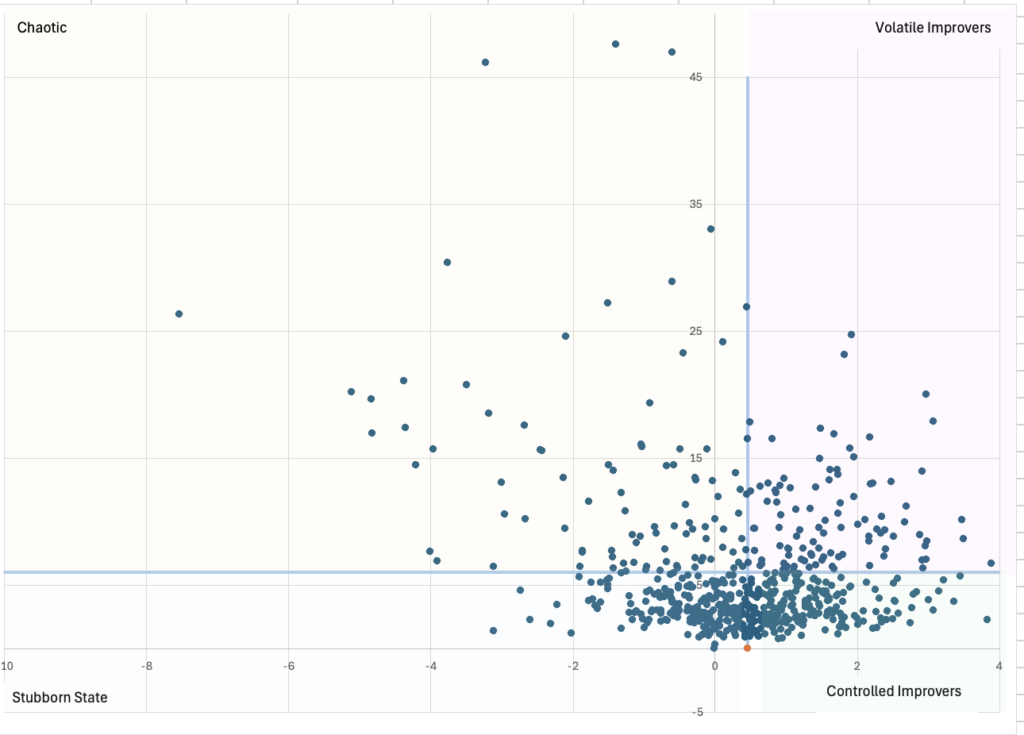
We analyse how outcomes change over time — and how stable those changes are.
- Trend shows direction of movement
- Noise shows how controlled or volatile that movement is
Noise is often mistaken for progress.
Stable progress and unstable drift are structurally different.
2. Feasibility vs Aspiration
Targets are often discussed in terms of outcomes.
We analyse the probability of achieving them.
Most targets are set without reference to probability.
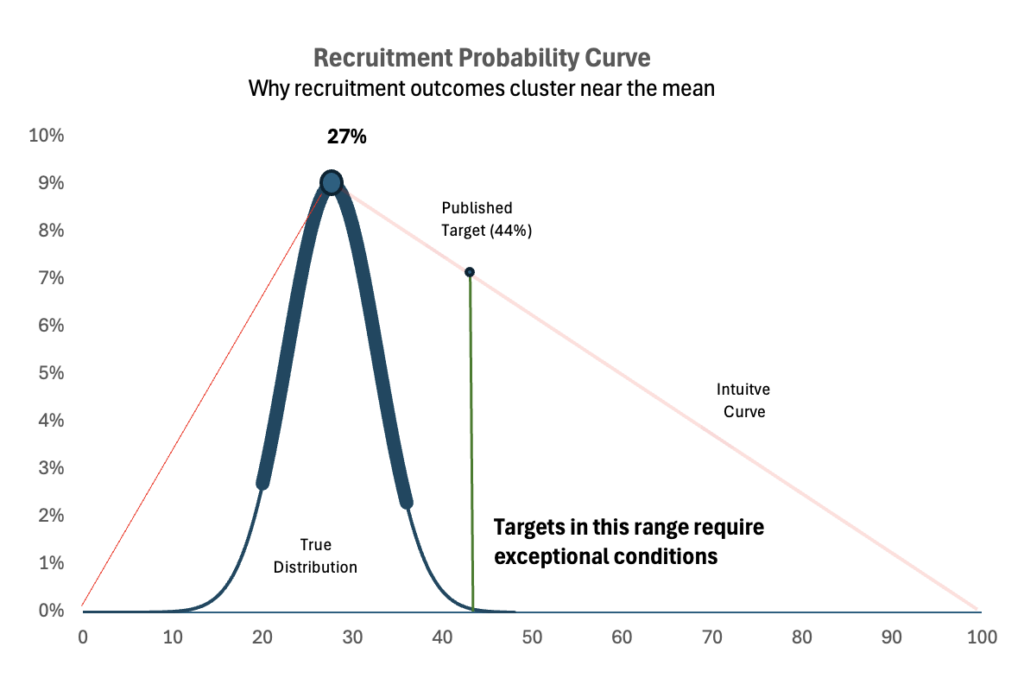
Targets are often set aspirationally.
Based on population share, targets often appear reasonable.
Analytically, the probability of achieving them may be very low.
We test whether a target is:
- achievable
- how long it will take
- what conditions would be required
Feasibility is a probability, not an assumption.
A target is only meaningful if it is structurally reachable.
3. Example: Workforce Transition
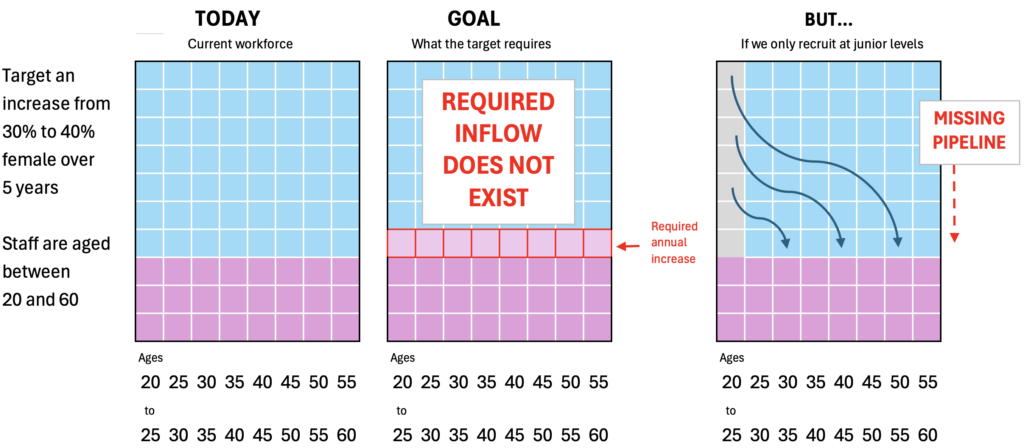
Consider a workforce with long careers and low turnover.
Even with sustained changes in recruitment, the overall composition adjusts slowly.
In many cases, near-term targets require:
- unrealistic hiring assumptions, or
- structural changes not visible in the headline target
Small changes in inflow produce large outcomes — but only over time.
These dynamics are not visible in headline metrics.
They require structured modelling.
Workforce systems move slowly, but predictably.